Structure-Preserving Deep Koopman Operator Learning Of Periodic Orbits In The Earth-Moon CR3BP
Abstract
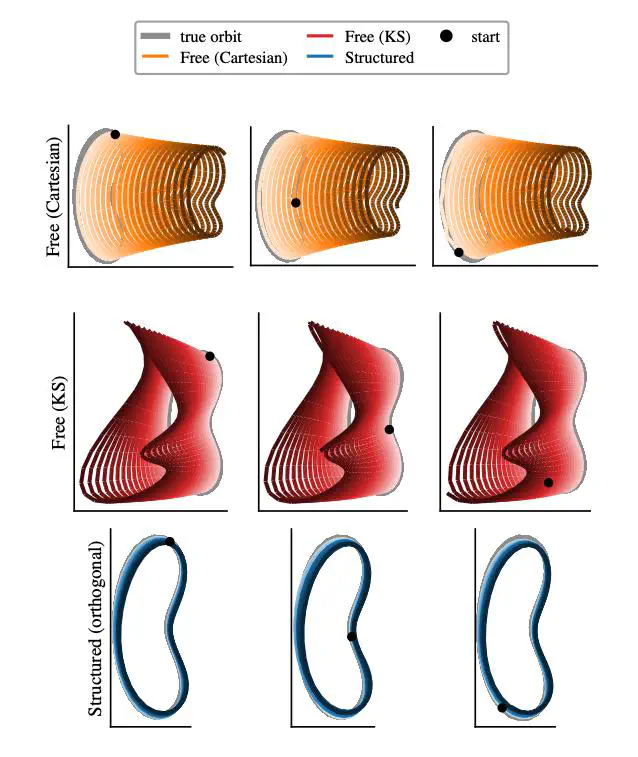
Designing missions in the Earth-Moon system relies on repeatedly propagating trajectories in the Circular Restricted Three-Body Problem (CR3BP), a strongly nonlinear system whose motion is costly to integrate far into the future. Machine-learned models promise a fast and cheap alternative, as they reduce each propagation step to a matrix multiplication. One approach toward that goal is Koopman operator theory, trading the nonlinear dynamics for a linear operator that acts on observables of the state. Deep Koopman methods learn this operator from trajectory data. In practice, though, a learned operator that is accurate over a single step tends to drift out of phase or diverge when run forward over a long horizon. We in- corporate known dynamics into the learning process, aiming to mitigate this issue. A classical change of coordinates, the Kustaanheimo-Stiefel (KS) transformation, exposes a simple oscillator hidden in the dynamics which we leverage in the learn- ing process. The operator is preconditioned with known dynamical properties gov- erning long-term stability rather than forced to discover them by training. Tested on Lyapunov orbits about the L1 libration point, the resulting model stays accurate at least sixfold longer than an unconstrained counterpart, bounds the drift of the Jacobi constant, and learns an ordered internal representation. This work provides a principled step toward a future in which nonlinear astrodynamics systems can be modeled and controlled using familiar and time-proven linear methods.